About Klar
Recovery Deserves Better Tools
Cannabis withdrawal is real, documented, and experienced by millions. Yet most people navigate it with nothing more than willpower and guesswork. Klar exists to change that.
Our Mission
Klar is a cannabis recovery app built on neuroscience — not judgment. We believe that understanding what is happening in your brain during withdrawal is the most powerful tool for getting through it.
The 90-day brain reset is not a marketing concept. It is grounded in published research on CB1 receptor upregulation and dopamine system normalization. Studies from the Journal of Neuroscience, JAMA Psychiatry, and Biological Psychiatry show that the endocannabinoid system requires approximately 28 days for significant CB1 receptor recovery and up to 90 days for full normalization.
We built Klar to make this science accessible — to turn abstract neuroscience into daily tools that help people see their brain healing in real time.
What Klar Does
90-Day Brain Reset Tracker
Visualize CB1 receptor and dopamine system recovery day by day, based on published neuroimaging research.
47 Symptom Tracking
Track every documented cannabis withdrawal symptom with expected timelines and severity curves.
Craving Surfing Tools
Science-backed urge management based on Mindfulness-Based Relapse Prevention (MBRP) research.
Identity Builder
Rebuild your sense of self beyond cannabis use — because lasting recovery requires identity change, not just abstinence.
Our Scientific Methodology
Every feature in Klar, every symptom timeline, and every piece of content on this website is grounded in peer-reviewed research. We do not make claims we cannot support with published evidence.
Reversible and regionally selective downregulation of brain cannabinoid CB1 receptors in chronic daily cannabis smokers
Molecular Psychiatry, 2012 — DOI
CB1 receptor density begins recovering within 2 days and reaches near-normal levels by day 28, with full normalization by approximately 90 days.
Deficits in striatal dopamine release in cannabis dependence
Molecular Psychiatry, 2016 — DOI
Striatal dopamine synthesis capacity is blunted in cannabis dependence and normalizes progressively over 4–12 weeks of abstinence.
Cannabis withdrawal syndrome: current insights
Substance Abuse and Rehabilitation, 2017 — DOI
Approximately 47% of regular cannabis users experience clinically significant withdrawal symptoms. CWS was added to DSM-5 in 2013.
Cannabis and sleep architecture: A systematic review and meta-analysis
Sleep Medicine Reviews, 2025 — DOI
Cannabis use suppresses REM sleep; REM rebound and sleep-architecture changes follow cessation.
Relative efficacy of mindfulness-based relapse prevention, standard relapse prevention, and treatment as usual
JAMA Psychiatry, 2014 — DOI
MBRP significantly reduces substance use and cravings compared to standard relapse prevention, with effects sustained at 12-month follow-up.
Symptom timelines, prevalence data, and brain recovery percentages in the app are derived from meta-analyses and longitudinal studies of cannabis cessation. Individual experiences vary — we present aggregate data to set realistic expectations, not guarantees.
Editorial Process
All content published on liveklar.com follows a structured editorial process:
- 1
Research: Content is drafted from peer-reviewed sources, clinical guidelines, and established neuroscience literature.
- 2
Writing: Articles are written in accessible language, avoiding both clinical jargon and oversimplification of complex neuroscience.
- 3
Fact-checking: All claims are cross-referenced against published research. Statistics are sourced from meta-analyses where available.
- 4
Review: Content is reviewed for medical accuracy, clarity, and alignment with current evidence before publication.
- 5
Updates: Articles are revisited when new research emerges or existing findings are updated.
We are transparent about the limitations of current research. Where evidence is preliminary or conflicting, we say so. Cannabis withdrawal research is a growing field — our content evolves as the science does.
Why Cannabis-Specific?
Most sobriety apps are built for alcohol or general addiction. Cannabis dependency has a distinct neurological profile — different withdrawal timeline, different symptoms, different psychological patterns.
The "Valley of Disappointment" — that period around weeks 4–6 where acute withdrawal has passed but life still feels flat — is specific to cannabis recovery and the dopamine normalization process. Generic sobriety apps do not account for this.
Klar was built by people who understand that cannabis dependency is often dismissed — by society, by healthcare providers, and even by the people experiencing it. We take it seriously because the neuroscience does.
What Shaped Our Approach
Beyond clinical neuroscience, two books deeply influenced how Klar approaches behavior change and recovery:
Atomic Habits
James Clear
The idea that lasting change comes from small, consistent actions — not willpower — runs through every Klar feature. Identity-based habit change, environment design, and the concept of the "Valley of Disappointment" (where results lag behind effort) directly shaped our recovery framework and how we help users push through weeks 4–6.
Dopamine Nation
Dr. Anna Lembke
Dr. Lembke's framework on the pleasure-pain balance and dopamine regulation informed how we visualize brain recovery. The 30-day dopamine reset concept, the importance of understanding tolerance and withdrawal as neuroadaptation rather than moral failure, and self-binding strategies are all woven into the app's approach.
Explore the data
The research above powers everything we publish — browse the symptom library, the recovery timeline, and the free calculators built on the same dataset.
Get in Touch
Questions about Klar, our content, or our methodology? We welcome the conversation.
- Email: support@liveklar.com
- Instagram: @klar.app
Science-backed recovery
Track your recovery with Klar
47 symptom tracking, brain recovery visualization, craving surfing tools, and the 90-day timeline—all in one app.
Start Your 90-Day Reset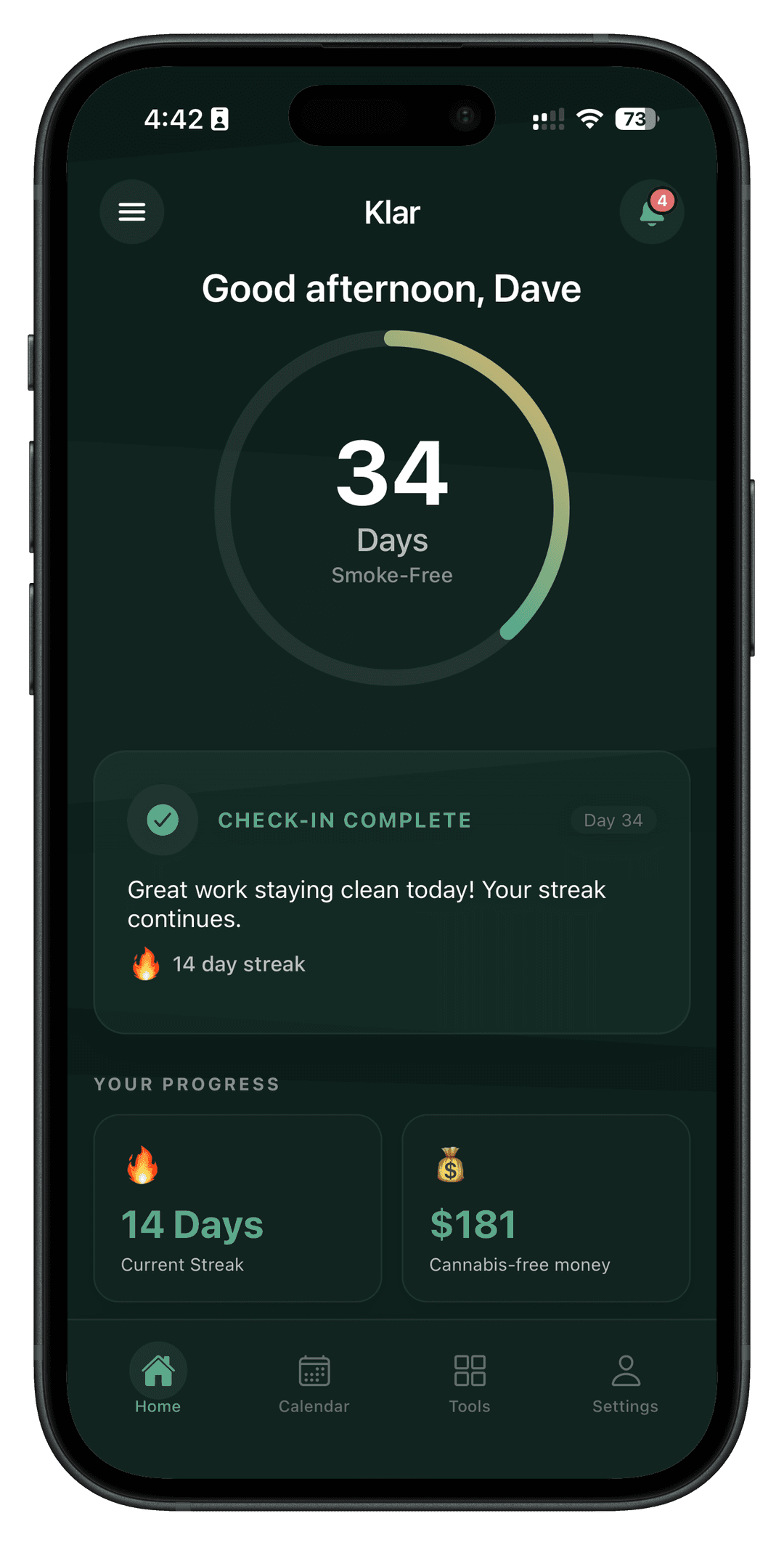
Medical Disclaimer: Klar is a wellness and self-tracking tool, not a medical device. Our content is for informational purposes only and does not constitute medical advice, diagnosis, or treatment. Always consult a qualified healthcare provider for medical guidance. If you are in crisis, call 988 (Suicide & Crisis Lifeline) or text HOME to 741741.