You've tried to quit before. Maybe you made it a few days, maybe a few weeks. Then a stressful day hit, or boredom crept in, and you were back. You're not alone—and you're not weak. The problem isn't your willpower. The problem is your approach.
Cannabis dependency rewires your brain's reward system in ways that make "just stopping" almost impossible for long-term users. But neuroscience has given us a roadmap for recovery—and it works. This guide walks you through the five evidence-based strategies that address the actual mechanisms of cannabis dependency.
Why Quitting Is Harder Than You Think
Quitting cannabis is difficult because of neuroadaptation, not lack of willpower. Regular cannabis use causes physical changes in the brain — CB1 receptor downregulation and reduced dopamine production — that make cessation genuinely challenging for the estimated 9% of users who develop Cannabis Use Disorder (NIDA, 2020).
Here's what most people don't realize: cannabis dependency isn't about a lack of discipline. It's about neuroadaptation. When you use cannabis regularly, your brain physically changes to accommodate the constant flood of THC.
Your endocannabinoid system—the network of receptors that THC hijacks—downregulates CB1 receptors. Your dopamine baseline drops. Your brain literally restructures itself around the assumption that THC will be present. When you remove it, your brain has to rebuild from scratch.
This is why the first few weeks feel so brutal. It's not weakness. It's neurochemistry.
The Brain Chemistry of Cannabis Dependency
Cannabis dependency involves two brain systems: the dopamine reward system and the endocannabinoid system. THC disrupts both — reducing natural dopamine production (van de Giessen et al., Molecular Psychiatry, 2016) and downregulating CB1 receptors (Hirvonen et al., Molecular Psychiatry, 2012). Both systems recover within approximately 90 days of abstinence.
Understanding what's happening in your brain is the first step to outsmarting it. There are two key systems at play:
The Dopamine System
THC triggers dopamine release in the nucleus accumbens—your brain's reward center. Over time, your brain reduces its natural dopamine production. This is why everything feels flat, grey, and meaningless when you first quit. Your brain hasn't forgotten how to produce dopamine—it's just been outsourcing the job to cannabis.
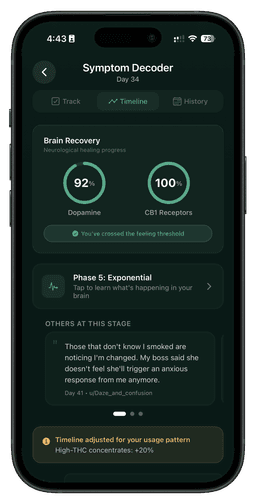
Research shows that dopamine receptor density begins recovering within the first 2 weeks, with substantial recovery by Day 28. Full normalization typically takes 60–90 days.
The Endocannabinoid System
Your body produces its own cannabinoids (anandamide and 2-AG) that regulate mood, sleep, appetite, and pain. THC overwhelms these receptors, so your brain reduces their numbers (downregulation). When you quit, you have fewer receptors and less natural cannabinoid production.
CB1 receptor density begins recovering around Day 2, with significant restoration by Day 28. Research from the Molecular Psychiatry found near-complete normalization by Day 90—which is exactly why the 90-day framework matters.
Why Willpower Alone Fails
Willpower is a finite neurological resource. It lives in the prefrontal cortex—the same brain region responsible for planning, decision-making, and impulse control. Here's the cruel irony: THC withdrawal directly impairs prefrontal cortex function.
So at the exact moment you need the most self-control, your brain has the least capacity for it. This isn't a character flaw. It's biology.
Effective recovery strategies work with your neurobiology, not against it. Here are five that do exactly that.
Strategy 1: Understand Your Timeline
One of the most powerful things you can do is know exactly what to expect and when. Uncertainty amplifies anxiety. When you know that Day 3–7 is peak physical withdrawal, that the "Valley of Disappointment" hits around Days 30–45, and that significant relief comes by Day 60–90, you can prepare for each phase.
The 90-day recovery timeline isn't arbitrary. It's based on the neurological recovery data for CB1 receptor density, dopamine regulation, and sleep architecture normalization.
Knowing your timeline transforms the experience from "will this ever end?" to "I'm exactly where I should be."
Strategy 2: Track Your Symptoms
Cannabis withdrawal produces up to 47 documented symptoms—from insomnia and irritability to vivid dreams and night sweats. When you're experiencing them in the moment, they feel permanent and overwhelming.
Tracking creates distance between you and the symptom. Instead of "I can't sleep and I'm going crazy," it becomes "Day 5: insomnia rated 7/10—this is expected to peak this week and improve by Day 14."
This isn't just psychological comfort. Research on self-monitoring shows it activates the prefrontal cortex (the rational brain), which directly counteracts the amygdala's panic response. You're literally using data to calm your nervous system.
Strategy 3: Surf Your Cravings
Cravings feel like they'll last forever. They don't. The neuroscience is clear: the average craving peaks at 15–20 minutes, then subsides. Every single time.
Craving surfing is a technique from Mindfulness-Based Relapse Prevention (MBRP). Instead of fighting the craving or giving in, you observe it—like watching a wave build, crest, and dissolve. You notice where you feel it in your body. You breathe through it. You wait.
The magic is this: every craving you surf without using weakens the neural pathway. Your brain literally learns that the craving doesn't need to be satisfied. Over time, cravings become less frequent and less intense. The first two weeks are the hardest. By Day 30, most people report cravings dropping by 60–70%.
Read our full guide on craving surfing technique for a step-by-step walkthrough.
Strategy 4: Rebuild Your Identity
Here's something most recovery programs miss entirely: when cannabis has been part of your identity for years, quitting isn't just about stopping a behavior. It's about becoming someone new.
"I'm a stoner" or "I smoke to relax" aren't just habits—they're identity statements. As James Clear writes in Atomic Habits, lasting change happens when you shift from outcome-based goals ("I want to quit") to identity-based ones ("I'm someone who chooses clarity").
Every day you don't use is a vote for your new identity. Every time you surf a craving, walk instead of smoking, or go to bed sober, you're casting a vote. You don't need a unanimous decision. You just need a majority.
Strategy 5: Visualize Your Progress
Your brain is healing—but you can't feel neurons regenerating. That's a problem, because the lack of visible progress is one of the biggest reasons people relapse, especially during the "Valley of Disappointment" (Days 30–45) when acute symptoms have passed but you still don't feel "normal."
Visualizing your brain's recovery—dopamine receptor density climbing back, CB1 receptors regrowing, sleep architecture normalizing—transforms an invisible process into something tangible. It's the difference between running on a treadmill and running toward a visible finish line.
This is neuroscience you can see. And seeing it makes all the difference during the hardest days.
Your First 24 Hours: An Action Plan
Ready to start? Here's what to do in the next 24 hours:
- Set your quit date. Pick today, or pick a date within the next 72 hours. Not "someday."
- Remove your supply. Throw away your stash, papers, pipes, vapes—everything. Making it harder to access removes the impulse option.
- Tell one person. Accountability matters. Text a friend, post on r/leaves, or just write it down for yourself.
- Prepare for tonight. The first night is often the hardest for sleep. Have chamomile tea, a book, melatonin (0.5–1mg), and a plan for what you'll do when you can't sleep instead of scrolling your phone.
- Start tracking. Download Klar and set your sobriety date. Log how you're feeling. You'll thank yourself at Day 30 when you can look back and see how far you've come.
Frequently Asked Questions
Is cannabis really addictive?
Yes. About 9% of all cannabis users and up to 30% of daily users develop Cannabis Use Disorder (CUD). Physical dependency is well-documented, with a defined withdrawal syndrome recognized in the DSM-5. It's not as immediately dangerous as opioid or alcohol withdrawal, but it's real and it's uncomfortable.
How long will withdrawal last?
Acute physical symptoms typically last 1—2 weeks. Psychological symptoms (anxiety, depression, cravings) can persist for 4–6 weeks. Most people report feeling significantly better by Day 60–90. Check out our complete recovery timeline for details.
Should I quit cold turkey or taper?
Research slightly favors cold turkey for cannabis (unlike alcohol or benzodiazepines, cannabis withdrawal is not medically dangerous). Tapering can extend the withdrawal period and make it harder to fully commit. However, if cold turkey feels impossible, reducing by 25% per week is a reasonable approach.
What if I've tried to quit before and failed?
The average person with a substance use disorder attempts to quit 7 times before succeeding. Every attempt teaches you something. This time, you have the science on your side.