2 Weeks Without Weed: Clarity Returns
Cognitive function begins recovering
Last updated: July 26, 2026
CB1 Receptor Recovery
30%
Dopamine System Recovery
30%
CB1 receptors have recovered roughly 30% of their density. Cognitive function is measurably improving. Sleep architecture is reorganizing toward normal patterns.
Two weeks. You’ve outlasted the acute phase and you’re beginning to experience something you may have forgotten: mental clarity. Thoughts are becoming sharper. Conversations flow more easily. You might catch yourself focusing on something for 30 minutes straight without realizing it. Your prefrontal cortex is coming back online.
What’s Happening in Your Brain
PET imaging studies show significant CB1 receptor recovery by day 14. Your hippocampus (memory) and prefrontal cortex (focus, planning) are regaining functionality as receptor density increases and neurotransmitter balance improves. Verbal memory and processing speed are measurably better than they were at day 7.
Sleep architecture is reorganizing. You’re spending more time in deep sleep (stages 3–4), which is when physical restoration and memory consolidation happen. Vivid dreams are still present but may be less intense than their peak at days 7–10.
What’s Improved
- Cognitive clarity — Verbal fluency, working memory, and focus are noticeably better
- Sleep — Falling asleep is easier. Total hours increasing. Still some vivid dreams.
- Physical — Appetite normalized. Physical energy returning.
- Cravings — Less frequent, more manageable, mostly situational
Remaining Challenges
- Emotional flatness may be settling in as dopamine recovery lags behind CB1 recovery
- Boredom — With physical symptoms gone, you face the question: what does life look like without cannabis?
- Social situations — You may face your first social trigger (friends smoking, parties, etc.)
Your Action Plan
1. Use Your Returning Clarity Productively
Your brain is getting sharper. Direct that toward something meaningful: a project, a goal, learning something new. Productive engagement builds the identity and reward pathways that replace cannabis.
2. Navigate Social Triggers
You may encounter cannabis in social settings for the first time since quitting. Have a plan: rehearse your “no thanks,” bring your own drink, know your exit strategy, and have someone you can text in the moment.
3. Watch for the Valley Ahead
Weeks 4–6 bring a challenging period we call the Valley of Disappointment. Physical symptoms are gone, but emotional flatness (anhedonia from dopamine system recovery) can make you question if quitting was worth it. It was. And it passes.
Two weeks is when you start seeing what sobriety can feel like. The clarity you’re experiencing is only going to deepen. Week 3 brings more of it.
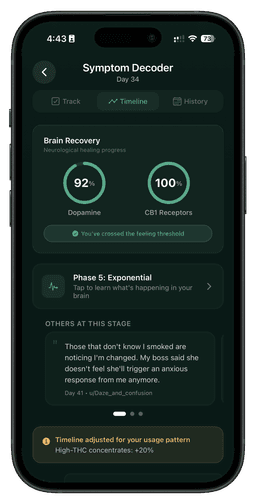
Track your progress
See your brain healing in real time
Klar tracks 47 withdrawal symptoms and visualizes your dopamine and CB1 receptor recovery day by day.
Related Articles
Medical Disclaimer: This content is for informational purposes only and does not constitute medical advice, diagnosis, or treatment. Always consult a qualified healthcare provider for medical guidance. If you are in crisis, call 988 (Suicide & Crisis Lifeline) or text HOME to 741741.
Every figure on this page traces to peer-reviewed research and the 30-symptom dataset behind Klar. How we source our data