
Difficulty concentrating, poor memory, and mental sluggishness after quitting weed reflect temporary cognitive impairment as your brain recalibrates neurotransmitter systems.
35-45% of people quitting cannabis
Peaks day 7
~Peaks day 30
Recovery Timeline
| Metric | Value |
|---|---|
| Prevalence among quitters | 35-45% of people quitting cannabis |
| Typical onset | Day 1 |
| Peak intensity | Day 7 |
| Expected resolution | ~Day 30 |
| Total duration | 29 days (approximate) |
You read the same paragraph three times and still can’t remember what it said. You walk into a room and forget why. Words that were on the tip of your tongue dissolve before you can say them. Cannabis withdrawal brain fog is real, measurable, and — importantly — temporary.
Why Quitting Weed Causes Brain Fog
THC impairs cognitive function while you’re high (everyone knows this). What fewer people realize is that regular cannabis use causes lasting changes to brain regions responsible for memory and attention, even when you’re sober. Specifically:
- Hippocampus. Dense with CB1 receptors, this region handles memory formation. Chronic THC exposure reduces hippocampal volume and disrupts synaptic plasticity (the mechanism behind learning).
- Prefrontal cortex. Responsible for focus, planning, and working memory. THC exposure reduces prefrontal cortex activity and gray matter density.
- Acetylcholine disruption. THC indirectly suppresses acetylcholine — the neurotransmitter critical for attention and memory. When you quit, acetylcholine systems take time to normalize.
When you stop using cannabis, these systems begin recovering, but recovery isn’t instant. The brain needs to rebuild receptor density, restore neurotransmitter balance, and in some cases, generate new neural connections. During this rebuilding period, cognitive performance dips below even your “while-using” baseline before it improves. This is the fog.
When Does It Start, Peak, and End?
- Onset: Days 1–3. Difficulty concentrating appears early, often masked by more dramatic symptoms like insomnia and anxiety.
- Peak: Days 5–10. This is when cognitive impairment is most noticeable — you may feel “dumber” than when you were using.
- Improvement: Days 14–21. Verbal memory and processing speed begin recovering measurably.
- Resolution: Days 28–90. Full cognitive recovery. Research shows that most cognitive deficits from cannabis use reverse within 72 hours to 28 days of abstinence, with heavier users taking longer.
A meta-analysis in JAMA Psychiatry found that cognitive impairments from cannabis use are largely resolved within 72 hours for moderate users, but can take up to 28 days for daily heavy users. By day 90, virtually all studies show complete cognitive recovery.
What Actually Helps
1. Accept Reduced Capacity (Temporarily)
Don’t schedule your hardest intellectual work during weeks 1–2. This isn’t laziness; it’s neurological reality. Plan demanding cognitive tasks for week 3 onwards when clarity starts returning.
2. Physical Exercise (Again)
Exercise increases BDNF (brain-derived neurotrophic factor), which directly supports the neuroplasticity your brain needs to recover. It also increases blood flow to the hippocampus and prefrontal cortex. Aerobic exercise for 30+ minutes, 4–5 times per week, measurably accelerates cognitive recovery.
3. Omega-3 Fatty Acids
DHA (found in fish oil, fatty fish, and algae supplements) is a structural component of brain cell membranes. Your brain needs raw materials to rebuild. Aim for 1,000–2,000mg DHA daily during recovery. This is one of the few supplements with strong evidence for supporting brain recovery.
4. Cognitive Challenge
Use your brain actively: read challenging material, learn something new, do puzzles, have complex conversations. Cognitive demand stimulates neuroplasticity and accelerates recovery. Think of it as physical therapy for your brain — uncomfortable but necessary.
5. Sleep Quality
Memory consolidation and neural repair happen primarily during sleep. If insomnia is disrupting your sleep, addressing that will accelerate brain fog recovery. These two symptoms are tightly linked.
When to Seek Professional Help
- Cognitive problems persist beyond 8 weeks with no improvement
- You’re experiencing confusion, disorientation, or memory blackouts
- Cognitive impairment is severe enough to affect your safety or employment
- You had cognitive issues before cannabis use (may indicate an underlying condition)
SAMHSA National Helpline: 1-800-662-4357 (free, confidential, 24/7)
Common questions
How long does brain fog last after quitting weed?+
Is brain fog normal when quitting cannabis?+
What helps with brain fog after stopping weed?+
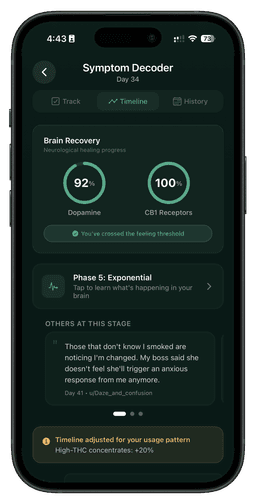
Track your progress
See your brain healing in real time
Klar tracks 47 withdrawal symptoms and visualizes your dopamine and CB1 receptor recovery day by day.
Related Symptoms
Related Timeline
Related articles
Medical Disclaimer: This content is for informational purposes only and does not constitute medical advice, diagnosis, or treatment. Always consult a qualified healthcare provider for medical guidance. If you are in crisis, call 988 (Suicide & Crisis Lifeline) or text HOME to 741741.
Every figure on this page traces to peer-reviewed research and the 30-symptom dataset behind Klar. How we source our data