THC Detox Calculator
Your THC Detox Timeline: How Long Does Weed Stay in Your System?
Get a personalized THC detox timeline: how long THC stays detectable in your body and how long your endocannabinoid system takes to fully recover. Based on published clinical research.
Your Profile
THC is fat-soluble — higher body fat stores more THC
THC detection windows by usage pattern
Typical detection windows from published toxicology ranges. Your personal window shifts with body fat, metabolism, dose, and consumption method — the calculator above personalizes these ranges.
| Usage pattern | Urine Test | Blood Test | Saliva Test | Hair Test |
|---|---|---|---|---|
| Occasional (1-2x/month) | 2–4 days | 1–2 days | 0.5–1 days | 90 days |
| Moderate (1-2x/week) | 5–10 days | 2–4 days | 1–2 days | 90 days |
| Regular (3-5x/week) | 10–21 days | 3–7 days | 2–4 days | 90 days |
| Daily | 15–30 days | 5–7 days | 3–5 days | 90 days |
| Heavy daily (multiple times/day) | 30–90 days | 7–14 days | 5–7 days | 90 days |
How THC-COOH levels decay over time
Illustrative decay of relative THC-COOH levels after quitting, by usage pattern. Heavier, longer use stores more metabolites in fat tissue, so the curve flattens — this is why detection windows differ so much.
What each drug test actually measures
Urine Test
Urine tests detect THC-COOH, the fat-stored metabolite — not active THC. Standard screening cutoff is 50 ng/mL with a ~15 ng/mL confirmation. Because THC-COOH releases slowly from fat tissue, urine has the longest variable window: 2–4 days after occasional use, up to 30–90 days after heavy daily use.
Blood Test
Blood tests measure active THC in serum, so the window is short: roughly 1–2 days for occasional use and up to 7–14 days for heavy daily use, as stored THC re-enters the bloodstream. Blood values are what driving-limit laws refer to.
Saliva Test
Saliva tests detect recent use — typically up to 24 hours after occasional use and up to about a week with heavy daily use. They are common in roadside checks because they indicate recent consumption rather than past use.
Hair Test
Hair analysis looks back roughly 90 days regardless of usage pattern: THC metabolites are deposited in the hair shaft as it grows (~1 cm per month), and segment analysis can even map months of use. It cannot show intoxication, only past exposure.
How this calculator works
The estimate starts from published toxicology detection windows for your usage pattern (the table above) and adjusts them with multiplicative factors for body fat, metabolism, activity level, consumption method, age, weight, dose, and years of use. The output is a range, not a point value — individual variation is real, and no calculator can replace a lab test. This tool is educational and not medical or legal advice.
Detection also depends on the test's cutoff: urine screenings typically flag at 50 ng/mL THC-COOH with lab confirmation around 15 ng/mL — a stricter cutoff extends the effective window. Blood limits for driving are set in ng/mL of active THC in serum and vary by country.
Every figure on this page traces to peer-reviewed research and the 30-symptom dataset behind Klar. How we source our data
The Science Behind Endocannabinoid System Recovery
When you use cannabis regularly, your body adapts by downregulating CB1 receptors — the primary targets of THC in the brain. This is why tolerance builds over time: your brain literally has fewer receptors responding to cannabinoids. Understanding this process is key to understanding recovery.
CB1 Receptor Upregulation
Research published in Molecular Psychiatry shows that CB1 receptor density begins recovering within 48 hours of abstinence. After 28 days, receptor availability in most brain regions returns to levels comparable to non-users. For chronic heavy users, full normalization may take up to 90 days. This recovery follows a predictable exponential curve — fast initial gains that gradually plateau.
Dopamine System Normalization
Chronic cannabis use blunts the dopamine system, particularly in the striatum. Studies using PET imaging demonstrate that dopamine release capacity is reduced in daily users. After cessation, dopamine signaling gradually normalizes over 4-6 weeks, which explains why motivation, pleasure, and drive often feel flat during early recovery before improving substantially.
Sleep Architecture Recovery
Cannabis suppresses REM sleep, which is critical for emotional processing and memory consolidation. When you quit, you may experience vivid dreams or nightmares as your brain rebounds with increased REM activity. Sleep architecture typically normalizes within 2-3 weeks, though some users report disrupted sleep for up to 45 days.
Cognitive Function Restoration
Working memory, attention, and executive function are all affected by chronic cannabis use. Meta-analyses show that most cognitive deficits resolve within 72 hours to 4 weeks of abstinence. However, heavy users who started young may experience longer recovery periods for complex executive functions.
The endocannabinoid system is remarkably resilient. While the first 2-4 weeks are the most challenging, the brain's natural cannabinoid signaling fully restores itself with sustained abstinence — a process you can track day by day with the Klar app.
Frequently Asked Questions
How long does THC stay in urine?+
Does body fat affect how long THC stays in your system?+
How long does the endocannabinoid system take to recover?+
Can you speed up THC detox?+
Why do I feel worse before I feel better after quitting cannabis?+
Is the endocannabinoid system recovery timeline the same for everyone?+
Can you speed up THC metabolism to pass a drug test?+
Is 30 days enough to get THC out of your system?+
How long do edibles stay in your system?+
Keep reading
Science-backed recovery
Track your recovery with Klar
47 symptom tracking, brain recovery visualization, craving surfing tools, and the 90-day timeline—all in one app.
Start Your 90-Day Reset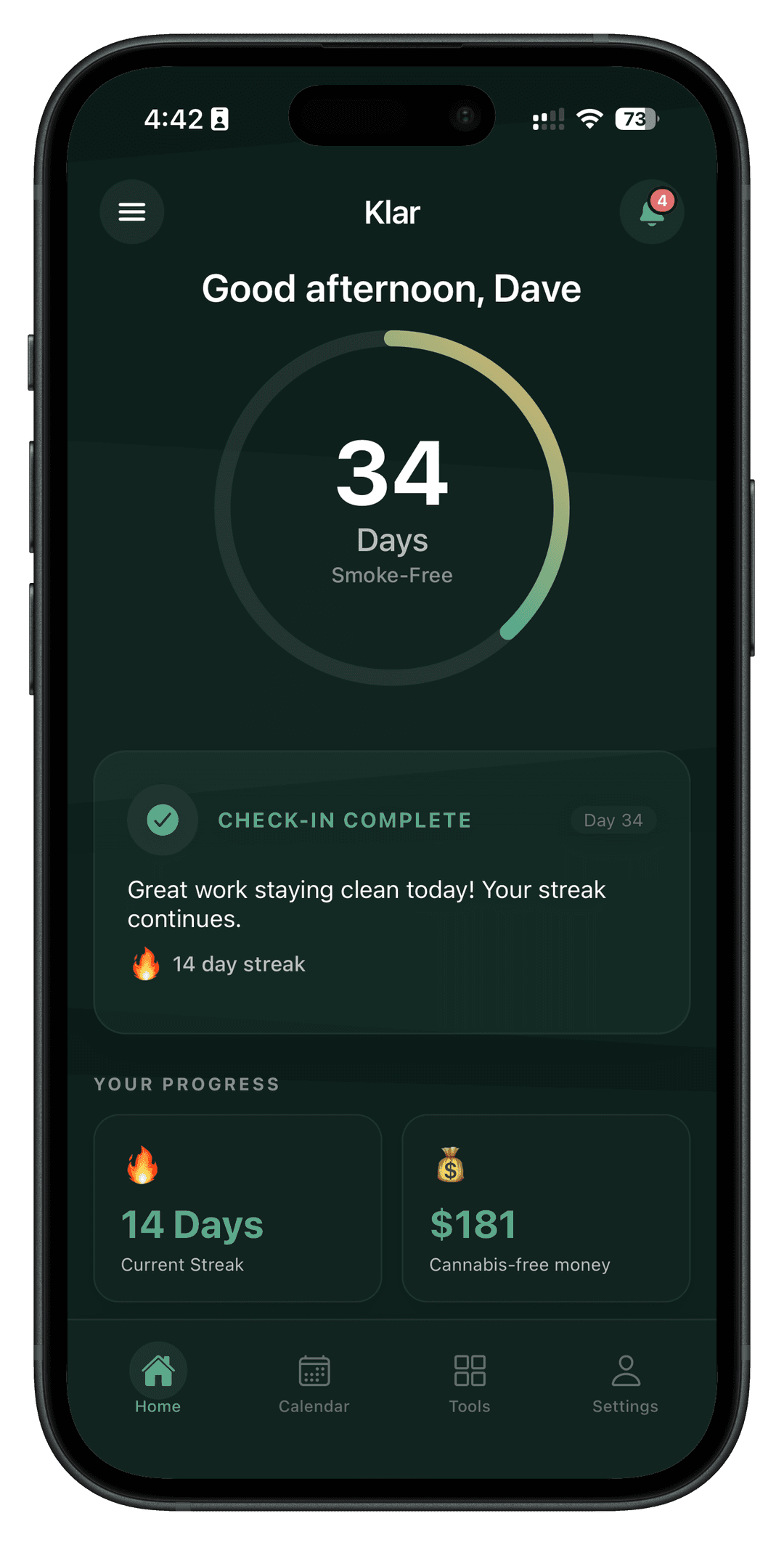
Medical Disclaimer This calculator provides estimates based on published research and should not be used as medical advice. Individual results vary significantly. Detection windows are approximate and should not be relied upon for legal or employment decisions. Always consult a healthcare professional for personalized guidance.